
One clench
01 / 04- Someone says a date you need to remember.
Design review with Elif
The cocktail party problem
Two people talk at once.Your brain solves it. Your earbuds do not.
When two voices compete, you lock onto the one you care about and push the other back. This has been understood for seventy years.
Modern earbuds cannot do it. They boost whatever is loudest, or nearest, or in front of you. In a restaurant, in an open office, on a conference floor, that guess is wrong most of the time.
Separating the voices was never the hard part. Knowing which one you wanted is.
How it works
Three things happenin under two seconds
- 01
You listen
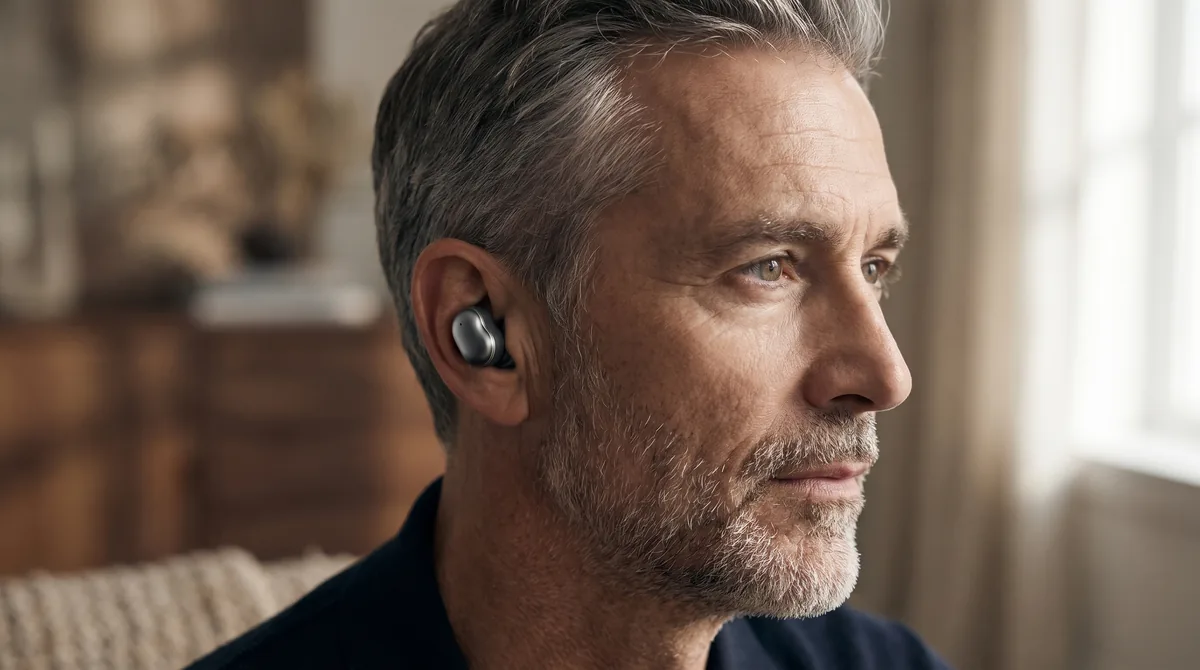
When you attend to a voice, your auditory cortex tracks its rhythm more strongly than the voices you are ignoring. The sensors in the eartip pick up that difference.
- 02
It follows
The earbud identifies which stream you are on and brings it forward. The rest recede. You did not press anything and you did not turn your head.
- 03
You act on it
This is the part that changes your day. Hear a date, a name, a task, a number. Clench your jaw once. The assistant already knows which conversation you were in, so it knows what you meant. The thing gets captured, filed, and handed back to you when you need it.
- A date
- A name
- A task
- A number
The eartip
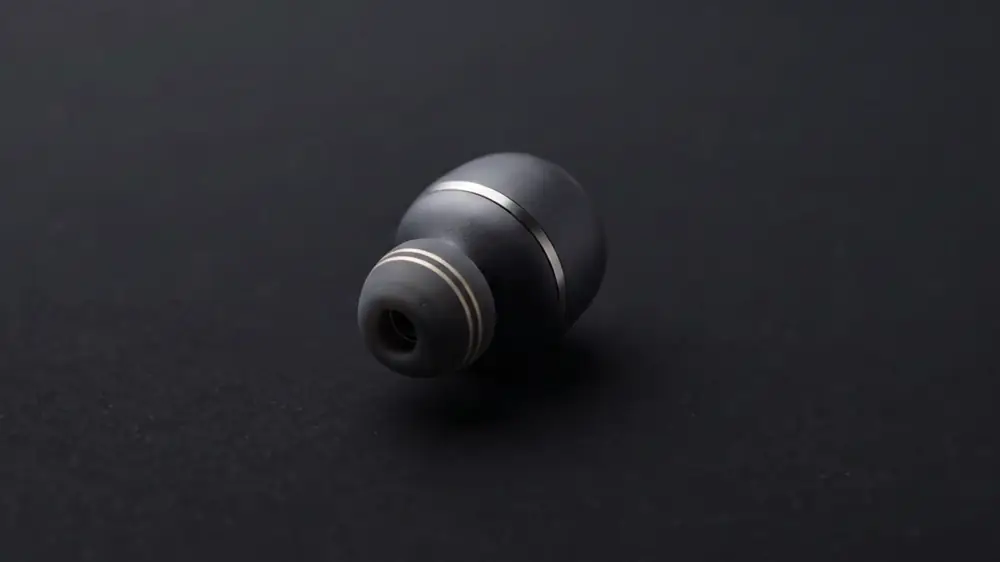
The sensor is the partyou already put in your ear
The contact rings sit flush in the silicone. Nothing clips on, nothing rests against your scalp, and nothing about it reads as equipment.
The ear is the only place on the body worn all day, millimetres from the auditory cortex, that nobody looks at twice.
The point
Every assistant needs you tostop what you are doing
Talking to an assistant in public does not work. Typing means leaving the conversation. That is why the most capable AI ever built sits unused in your pocket during exactly the moments you could use it.
A single jaw clench is invisible and unambiguous. It takes no hands, no screen, and no pause in what you were doing.
The vocabulary
Three gestures. No interruption.Capture this
Marks the last thirty seconds. Dates go to your calendar, names go to your contacts, tasks go to your list.
Saved to calendar
Design review with Elif
Thursday 14 May · 15:00
Three gestures cover everythingbecause it knows where you are
The same double clench means skip while you are listening to music and take that back while you are listening to a person. Attention supplies the context, so the gesture does not have to carry it. This is why we do not need a menu, a wake word, or a vocabulary you have to memorise.
Where it earns its place
Four rooms your earbuds get wrong

The meeting
Follow one person, keep every action item

The restaurant
Hear the person across from you

The handover
Capture a number without breaking eye contact

The race
Take a call at kilometre thirty
Plainly
It does not read your mind
It cannot, and neither can anything else you can wear without surgery. Two things go into this device. Which sound you are attending to, and a small movement you make on purpose. Nothing you think is measured, transmitted, or stored.
It is also not a hearing aid, and we make no medical claims about it.
We would rather tell you this on the first page than have you find out later.
The science
Fifteen years of published work,finally small enough to wear
Auditory attention decoding is an established research field. The open questions were never whether the signal exists. They were signal quality in a device this small, decision speed, and how much calibration each person needs.
That is what we work on.
~83%
Attention decoding accuracy reported in laboratory conditions using full scalp sensors
Published laboratory reference, not a Signalive product measurement
<2 sec
The decision window a wearable product has to work within
Design target
4
Sensors per ear our design targets
Design target
The first five hundred
We are building a small first run for people who spend their day in noise. Tell us where you spend yours.
No spam. One email when units are ready.